
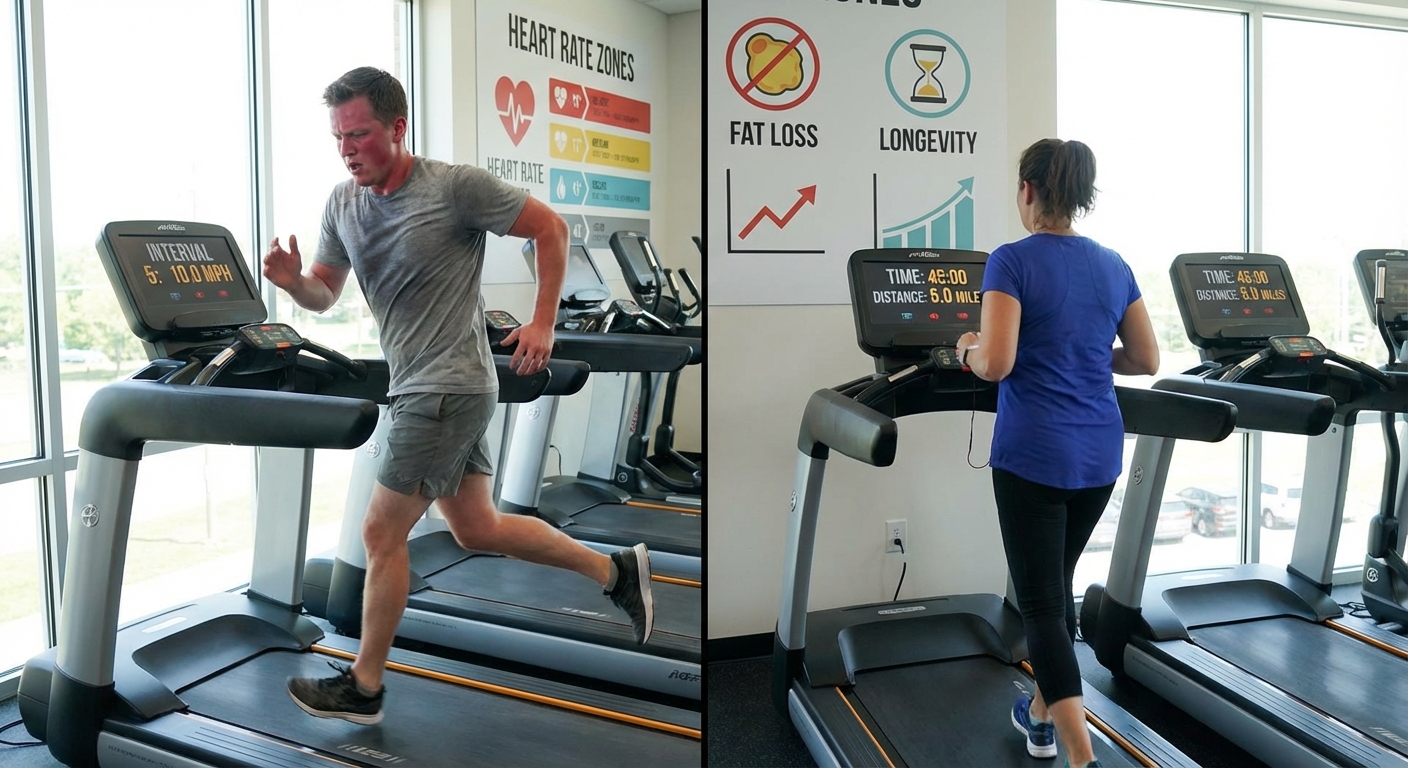
In fitness culture, HIIT is often praised as the magic bullet, while steady-state cardio gets called “boring” or “inefficient.” The truth, supported by research, is that both styles are powerful tools—if you use them for the right goals and in the right doses.
Why This Debate Matters
This article breaks down the science of HIIT and steady state, then gives practical templates so you can build the right mix for fat loss, performance, and long-term health.
What Is Steady-State Cardio Really Doing in Your Body?
Definition: Cardio at a relatively constant pace and intensity for an extended period (usually 20–60+ minutes).
Intensity: Mostly 55–75% of max heart rate.
Physiological Benefits:
- Increases stroke volume (the amount of blood your heart pumps per beat)
- Improves capillary density (more blood flow to working muscles)
- Enhances the body’s ability to oxidize fat at rest and during exercise
- Builds an aerobic “base” that supports all other training
Research shows that 150–300 minutes/week of moderate-intensity cardio is associated with markedly lower risk of cardiovascular disease and all‑cause mortality.
Practical Takeaway: Steady state is the foundation. It’s low stress, sustainable, and critical for long‑term health.
What HIIT Actually Changes in Your System
Definition: Short bursts of high‑intensity work (>80–90% of max heart rate) with periods of rest or low-intensity activity.
Physiological Benefits:
- Rapid improvements in VO₂ max (a key marker of cardiorespiratory fitness)
- Improved insulin sensitivity and glucose control
- Time‑efficient improvements in endurance and performance
Studies comparing HIIT to moderate cardio often show similar or greater gains in fitness with less total training time—but HIIT is also more taxing on the nervous system and joints.
Practical Takeaway: HIIT is a potent tool—like a high‑powered spice. Use it strategically, not as your only form of cardio.
Which Is Better for Fat Loss?
Both can work. Here’s how they compare:
Steady State for Fat Loss
Pros:
- Easier to perform in a calorie deficit
- Lower injury and burnout risk
- Can accumulate more total volume (and thus total calories burned)
Cons:
- Takes more time per session
- Can feel monotonous if not varied
HIIT for Fat Loss
Pros:
- High calorie burn per minute
- Increases EPOC (excess post‑exercise oxygen consumption), meaning slightly more calories burned after sessions
- Protects performance and conditioning when dieting
Cons:
- Harder to recover from in a calorie deficit
- Higher risk of overuse injuries if overdone
- Not ideal for beginners or those with heart/joint issues
Evidence: Most research indicates that when diet is controlled, fat loss is similar between HIIT and steady state. The best choice is the one you can adhere to consistently while maintaining strength and recovery.
Building Your Cardio Mix By Goal
1. Goal: General Health & Longevity
Priority: Sustainability, enjoyment, and cardiovascular protection.
- Primary: Steady state (walking, cycling, swimming)
- Secondary: Optional light intervals
Weekly Template:
- 3–5 × 30–40 minutes moderate cardio (brisk walking, cycling)
- Optional: 1 short interval session (e.g., 6 × 30 sec faster walk + 90 sec easy)
2. Goal: Fat Loss While Preserving Muscle
Priority: Manage fatigue while increasing energy expenditure.
- Primary: Steady-state and low-impact cardio
- Strategic: 1–2 HIIT days/week if recovery allows
Weekly Template (with strength training 3–4 days/week):
- 2–3 × 30–45 minutes low to moderate cardio (post-workout or separate)
- 1–2 × HIIT sessions (10–20 minutes work time) on non-leg‑lifting days
Example HIIT Session (Bike or Row):
- 8–10 min easy warm-up
- 8 × 20 sec hard + 100 sec easy
- 5–10 min cool-down
3. Goal: Performance (Running, Sports, Conditioning)
Priority: Aerobic base + specific high-intensity work.
- 1–2 long steady sessions for endurance
- 1–2 tempo or threshold sessions
- 1–2 HIIT/speed sessions
Example Weekly Mix:
- Mon: Intervals (HIIT): 6–10 × 400 m fast with equal or slightly shorter rest
- Wed: 30–45 min easy run or cycle
- Fri: Tempo run: 20 min at comfortably hard pace
- Weekend: 45–75 min long easy session (conversational pace)
Exercise Form Considerations: Protecting Joints at Any Intensity
For Steady State
- Choose lower-impact modes if you’re heavier, older, or injury‑prone: cycling, elliptical, swimming, incline walking.
- Vary terrain or machines to avoid repetitive strain.
For HIIT
- Warm up thoroughly (8–10 minutes, gradually increasing intensity).
- Keep technical movements (like box jumps or sprints) early in the session, when you’re freshest.
- Limit high‑impact HIIT (jumping, hard sprints) to 1–2 days per week unless you’re well-conditioned.
Nutrition: Fueling Each Cardio Type
Fueling Steady‑State Cardio
For most 30–60 minute moderate sessions:
- A normal meal 2–3 hours pre‑workout is enough.
- If training fasted or early, a small carb‑focused snack (fruit, toast, granola bar) can stabilize energy.
- Hydrate with water; add electrolytes if sweating heavily.
Fueling HIIT
High-intensity work relies heavily on carbohydrates:
- Eat 20–40 g carbs 60–90 min before HIIT (fruit, oats, rice cakes, sports drink).
- After HIIT, aim for 20–30 g protein plus 0.5–1 g carbs/kg within 1–2 hours.
- Avoid very high‑fat meals right before; they slow digestion and can cause discomfort.
Tracking the Impact of Each Type
To know if your mix is working, track more than just weight.
For Steady State
- Distance covered in 30 minutes at the same perceived effort
- Average heart rate on a familiar route or machine setting
- Resting heart rate over weeks
For HIIT
- Interval pace or power (e.g., treadmill speed, bike wattage) at the same effort
- Number of intervals you can complete with consistent quality
- Time it takes for heart rate to drop 20–40 beats after a hard interval
Re-test every 4–6 weeks and adjust your ratio of HIIT to steady state based on progress and how you feel.
Putting It All Together: Your Personalized Cardio Formula
- Define your primary goal: health, fat loss, or performance.
Choose your base:
- Health: mostly steady state - Fat loss: mostly steady state + 1–2 HIIT - Performance: mixed approach with structured high-intensity days 3. Match intensity to your life load: If stress and sleep are poor, favor more LISS and fewer HIIT sessions. 4. Progress slowly: Increase weekly cardio time or intensity by about 5–10% per week, not more.
You don’t have to pick a side in the HIIT vs steady-state debate. Use both intelligently. Steady state builds your engine; HIIT sharpens your edge. The right combination for you is the one that moves you toward your goals while leaving you energized—not exhausted—for the rest of your life.