
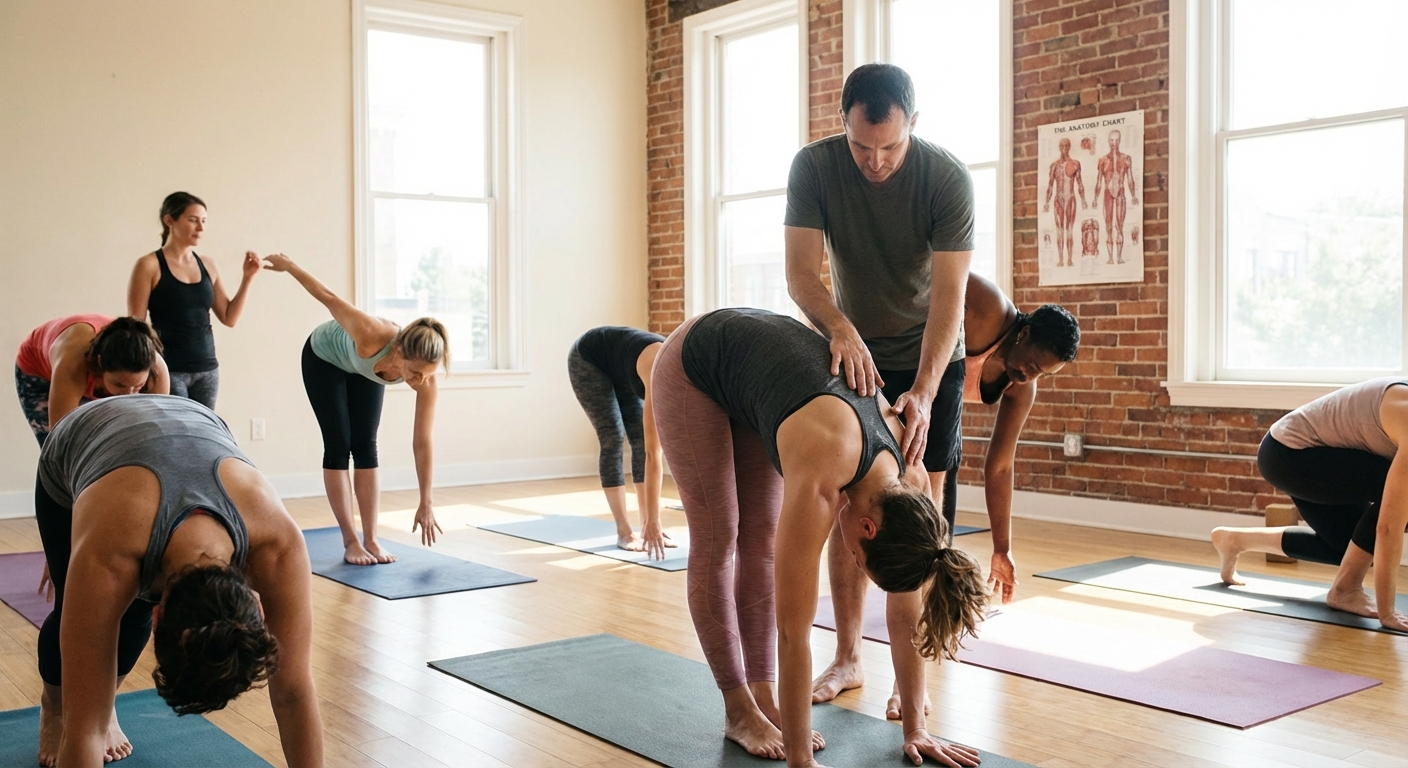
Most people think flexibility is just about touching your toes. In reality, true flexibility is a blend of:
Why Flexibility Isn’t Just About Stretching Further
- Joint range of motion
- Muscle length and tension
- Nervous system tolerance to stretch
- Strength in extended positions
Yoga integrates all four. Instead of forcing muscles longer, yoga helps the nervous system feel safe in new ranges of motion. Research shows that regular yoga can improve flexibility, mobility, balance, and even pain levels—without the injury risk of aggressive stretching.
A 2016 review in the International Journal of Yoga found that yoga programs improved flexibility and functional movement in both beginners and trained athletes. That’s why yoga is used in strength training programs, endurance sports, and rehab settings.
How Yoga Builds Flexibility Safely
Yoga works differently than static stretching:
Active ranges, not just passive stretching
Many poses require you to hold your body against gravity, engaging muscles while lengthened. This builds strength at end-range, which protects joints and ligaments.
Breath lowers nervous system tension
Slow, deep breathing triggers the parasympathetic nervous system, reducing muscle guarding. This allows more comfortable, sustainable gains in range of motion.
Controlled tempo and mindful awareness
You’re not yanking into a stretch. You ease in, notice sensation, and back off from pain. Over time, your brain updates what it considers a “safe” range.
Smart Training Principles for Flexible Gains
To get results—and avoid overdoing it—follow these science-backed rules:
- Frequency beats intensity: 10–20 minutes of yoga, 4–5 days per week, outperforms a single long, aggressive stretching session.
- Mild discomfort is okay; sharp pain isn’t: Aim for 3–6/10 intensity in stretch sensation. Back off if you feel pinching, burning, or joint pain.
- Hold times matter: 20–45 second holds in flexibility-focused poses are ideal for most adults.
- Warm, not cold: Light movement or a brisk 5–10 minute walk before yoga makes tissues more responsive.
A 3-Level Yoga Flexibility Routine
Use the level that fits your current ability. You can also combine them: start with Level 1 as a warm-up, Level 2 as the main practice, and add a pose or two from Level 3 as a goal.
Level 1: Beginner-Friendly (15–20 Minutes)
Goal: Gently improve mobility and body awareness.
Perform each pose for 3–5 slow breaths.
Cat–Cow (Spine)
- Start on hands and knees, wrists under shoulders, knees under hips. - Inhale: arch your back, lift chest and tailbone (Cow). - Exhale: round spine, tuck chin and tailbone (Cat). - Form tip: Move from the pelvis first; don’t just drop your belly.
Child’s Pose (Hips & Back)
- Kneel, sit hips toward heels, walk hands forward, forehead to floor or block. - Form tip: If knees hurt, place a rolled towel behind them or widen knees.
Low Lunge (Hip Flexors)
- Step right foot forward, left knee down. - Stack right knee over ankle, gently shift hips forward. - Form tip: Keep ribs stacked over hips; don’t over-arch your low back.
Seated Forward Fold (Hamstrings)
- Sit tall, legs extended. - Hinge from hips, reach toward feet. - Form tip: Bend knees slightly to keep back long and avoid rounding.
Supine Twist (Spine & Glutes)
- Lie on back, draw right knee to chest, guide it across body. - Extend right arm to the side, look right. - Form tip: Keep both shoulders heavy; use a pillow under knee if needed.
Repeat left/right as needed.
Level 2: Intermediate Flow (25–30 Minutes)
Goal: Combine strength, balance, and flexibility.
Hold each pose for 5–8 breaths unless otherwise stated.
Downward-Facing Dog
- From hands and knees, lift hips to an inverted V. - Form tip: Bend knees slightly to lengthen spine; press through full hands.
Crescent Lunge
- From Down Dog, step right foot forward, back heel lifted. - Inhale arms overhead, ribs stacked over pelvis. - Form tip: Back leg is active; imagine dragging feet toward each other.
Pyramid Pose (Hamstrings)
- From Crescent, straighten front leg, hinge over it. - Hands on blocks or shin. - Form tip: Keep hips level; avoid collapsing chest toward knee.
Warrior II → Side Angle
- From standing, step wide, toes turned slightly in, right foot turned out. - Bend right knee over ankle (Warrior II). - Then forearm to thigh, left arm overhead (Side Angle). - Form tip: Knee tracks over middle toes; don’t let it cave inward.
Pigeon Pose (Glutes & Hips)
- From all fours, bring right knee toward right wrist, shin angled. - Extend left leg back, fold forward. - Form tip: If hips are far from floor, place a cushion under front hip.
Repeat on the left side.
Level 3: Athlete’s Mobility Set (30–40 Minutes)
Goal: Advanced flexibility with end-range strength.
Lizard Lunge (Deep Hip Opener)
- From a low lunge, bring both hands inside front foot. - Option: drop back knee, or keep it lifted for more intensity. - Active variation: Gently press front knee into arm; then draw knee in.
Half Splits → Active Hamstring Lifts
- From low lunge, shift hips back, front leg straight, heel down. - After holding, slightly lift front heel off floor for 5 slow reps. - Form tip: Keep hips stacked over back knee; avoid rounding spine.
Bridge Pose → Single-Leg Bridge
- Lie on back, feet hip-width. Press into feet, lift hips. - Progression: extend one leg while keeping hips level. - Why: Strengthens glutes and hamstrings to support flexibility gains.
Wide-Leg Forward Fold with Strength
- Stand wide, hinge forward, hands on floor or blocks. - Gently contract inner thighs, then relax and fold deeper.
Supported Deep Squat (Malasana)
- Feet slightly wider than hips, turn toes out. - Sink into squat, elbows inside knees, hands at heart. - Form tip: Elevate heels on plates/blocks if ankles are tight.
Nutrition for Better Flexibility and Tissue Health
Flexibility isn’t only about stretching—your tissue quality matters:
- Hydration: Dehydrated fascia and muscles feel stiff. Aim for ~30–35 ml/kg of body weight daily, more if you sweat heavily.
- Protein (1.6–2.2 g/kg body weight/day if active): Supports muscle repair as you stress tissues in new ranges.
- Omega-3 fats (fish, flaxseed, walnuts): May help reduce inflammation, supporting recovery.
- Collagen + Vitamin C: Some evidence suggests 10–15 g collagen plus vitamin C taken 30–60 minutes before loading joints may support connective tissue.
- Magnesium-rich foods (leafy greens, pumpkin seeds, legumes): Magnesium is involved in muscle relaxation and nerve function.
Tracking Your Flexibility Progress (Beyond “Feeling Looser”)
Don’t rely only on vague sensations. Use objective measures:
- Photo checks: Take side and front photos in 3–4 key poses (Forward Fold, Lunge, Squat, Pigeon) every 4 weeks.
- Range-of-motion notes:
- How far are your hands from the floor in a forward fold?
- Can you squat deeper without heels lifting?
- Can you sit cross-legged comfortably?
- Performance markers:
- Less stiffness after workouts
- Stronger, more stable end ranges (e.g., fewer wobbles in lunges)
Log your yoga sessions (duration, poses, sensations) like you log reps and sets. Flexibility is a trainable quality—treat it with the same seriousness.
Common Mistakes to Avoid
- Bouncing into stretches: Increases injury risk and doesn’t create safer range of motion.
- Chasing “Instagram poses”: Advanced shapes mean nothing if your joints aren’t supported by strength.
- Ignoring pain signals: Joint pain, sharp pulling, or numbness is a stop signal, not a challenge.
- Only stretching what feels tight: The tight area is often overworking for a weak or underused neighbor (e.g., tight hamstrings + weak glutes).
Build Your Flexible, Strong Body—One Session at a Time
Flexibility is not a gift; it’s a skill you train. Yoga gives you a structured, evidence-based way to do it: controlled breathing, gradual exposure, and strength in new ranges.
Start with 10–20 minutes, 3–5 days per week. Track your poses, support your body with solid nutrition, and let your flexibility evolve as part of a stronger, more capable you.