
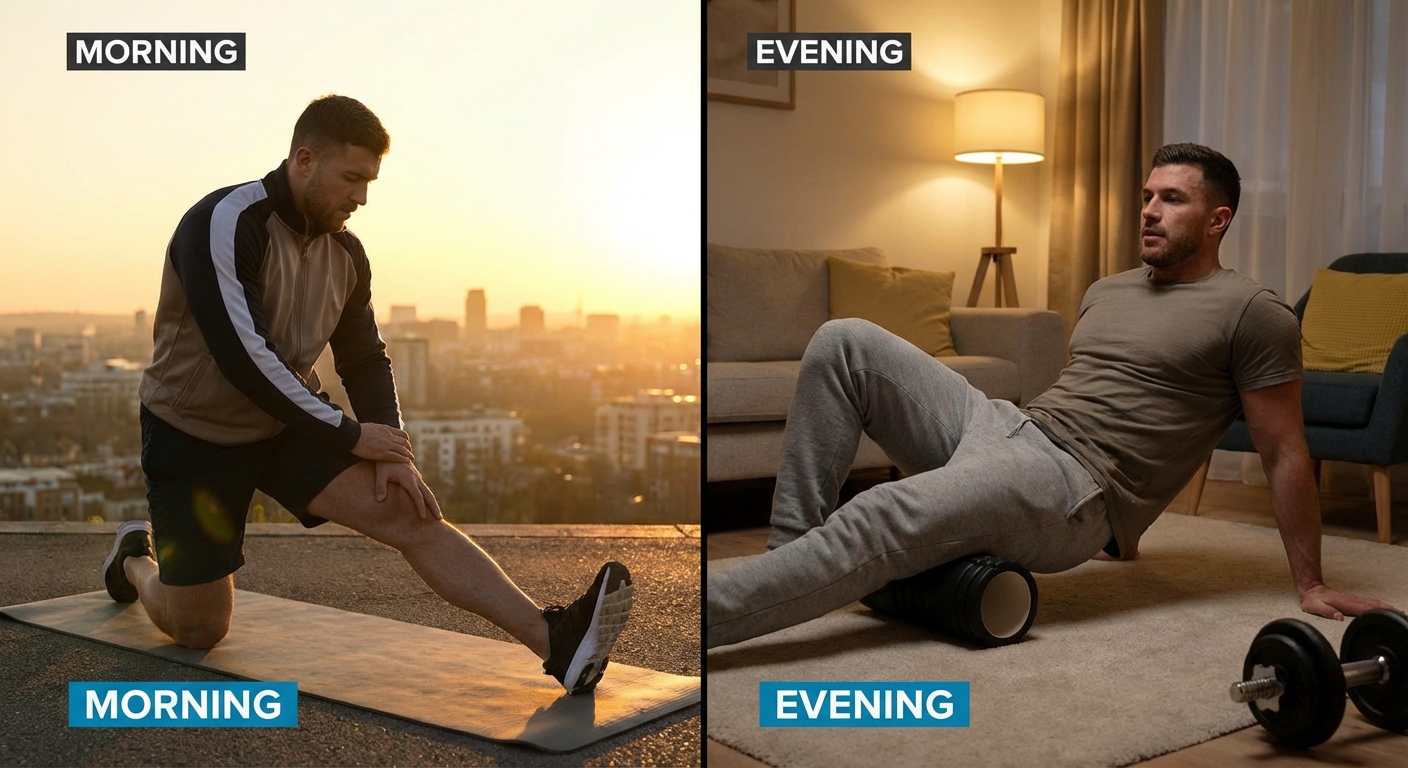
If you lift, run, or train hard, you’ve probably felt the tug-of-war between time and recovery. Long yoga classes can be amazing—but not always realistic.
You Don’t Need 90 Minutes of Yoga to Move Better
The solution: short, targeted yoga sessions integrated into your day. Think 10–15 minutes in the morning to unlock your joints, and 10–15 minutes at night to unwind and restore.
This system is built for busy lifters and fitness enthusiasts who want more flexibility, less stiffness, and better performance—without overhauling their schedule.
Why Split Your Yoga: Morning vs. Evening
Morning mobility should:
- Warm up joints and tissues
- Wake up your nervous system
- Prep you for lifting, work, or daily movement
Evening recovery should:
- Downshift your nervous system
- Release accumulated tension from training or sitting
- Improve sleep quality and next-day performance
By splitting yoga this way, you match the session’s intensity to your body’s needs.
Morning Mobility Flow (10–15 Minutes)
Goal: Lubricate joints, gently lengthen muscles, and prime your body for the day.
Use this 4–6 days per week.
1. Breath Wake-Up (1–2 Minutes)
- Sit tall on the edge of a chair or on a pillow.
- Inhale through nose for 3–4 seconds, exhale through nose for 3–4 seconds.
- Keep breaths light but intentional.
This shifts you from groggy to focused without over-relaxing.
2. Spinal Mobility Sequence (3–4 Minutes)
Cat–Cow x 8–10
- On hands and knees, alternate between gentle arching and rounding. - Move slowly; sync breath with movement.
Thread the Needle x 3–5 breaths each side
- From hands and knees, slide one arm under the other, lowering your shoulder and head. - Reach through, then come back up.
Loaded Child’s Pose x 5 breaths
- From hands and knees, push hips back toward heels with arms long. - Gently press hands into floor as if sliding it away.
3. Hip & Hamstring Wake-Up (4–5 Minutes)
Low Lunge to Half Splits Flow x 4 cycles per side
- Step right foot forward into low lunge, back knee down. - Inhale: sink hips slightly forward. - Exhale: shift hips back, straighten front leg for Half Splits. - Repeat 4 times, then switch.
Benefits: Gradual exposure for hip flexors and hamstrings—perfect pre-lift.
Standing Hip CARs (Controlled Articular Rotations) x 3 each direction
- Stand holding a counter or wall for balance. - Lift one knee, draw a large slow circle with the hip, keeping torso stable. - Move only as far as you can with control.
4. Shoulder & Ankle Primer (3–4 Minutes)
Downward-Facing Dog x 5–8 breaths
- Hands shoulder-width, hips high, knees slightly bent. - Pedal heels gently to wake up calves and ankles.
Wall Angels x 8–10 reps
- Stand with back against a wall, arms in "goalpost" position. - Slide arms up and down as if making a snow angel, keeping ribs down.
Ankle Rockers x 10 reps per side
- Stand in split stance, front foot flat. - Gently drive knee forward over toes while keeping heel down.
Evening Recovery Flow (10–15 Minutes)
Goal: Calm your system, relieve tightness from lifting/desk time, and support deep sleep.
Use 3–5 days per week. Best done at least 30–60 minutes after your last meal.
1. Down-Regulation Breathing (2–3 Minutes)
Use 4–6 breathing:
- Inhale through nose for 4 seconds.
- Exhale through mouth (or nose) for 6 seconds.
- Light, quiet, effortless.
Focus on expanding lower ribs and belly on the inhale. This signals safety to your nervous system.
2. Long-Hold Hip & Hamstring Release (6–8 Minutes)
Reclined Figure-4 (Supta Kapotasana)
- Lie on your back, cross right ankle over left knee. - Thread hands behind left thigh and gently pull toward you. - Hold 1–2 minutes per side.
Supported Hamstring Stretch
- Keep lying down, loop a strap/towel over right foot, leg extended. - Gently draw toward you; relax shoulders. - 60–90 seconds each leg.
Happy Baby Pose (Optional)
- On your back, grab shins or feet, knees toward armpits. - Gentle rocking side to side for 45–60 seconds.
3. Spine & Shoulder Unwind (4–5 Minutes)
Supine Twist
- On your back, draw right knee to chest, guide it across body. - Reach right arm to the side, palm up. - Hold 60–90 seconds per side.
Chest Opener at Wall or Doorframe
- Place forearm on wall at shoulder height, elbow bent. - Step forward and gently rotate chest away. - 45–60 seconds per side.
Supported Child’s Pose
- Kneel, sit hips back, place chest on a pillow or folded blanket. - Forehead supported; arms forward or relaxed by sides. - 1–2 minutes with slow breathing.
Form and Safety: Micro-Details That Matter
- Ease over effort at night: Evening yoga is not the time to chase maximum stretch intensity. Aim for 3–4/10.
- Joints, not ego: Never force knee or low-back positions just to "go deeper"—especially in twists and deep hip work.
- Props are performance tools:
- Use pillows under knees, hips, or head.
- Use straps or towels to extend reach.
- These allow better alignment and deeper relaxation.
Nutrition Habits That Support Mobility
You don’t need a special "flexibility diet," but these habits make your tissues more responsive:
- Hydrate gradually all day:
Caffeinated lifters often under-hydrate. Aim for pale yellow urine and sip water or electrolyte drinks.
- Prioritize protein in each meal:
20–40 g per meal (depending on size/activity) supports recovery from both lifting and end-range isometric work.
- Include collagen-building nutrients:
- Collagen or gelatin (10–15 g) + vitamin C taken ~30–60 minutes before joint loading may support connective tissue.
- Foods: citrus, berries, bell peppers, slow-cooked meats, bone broth.
- Anti-Inflammatory Plate:
Fill half your plate with plants (vegetables, fruits) at least twice daily.
Tracking Progress in 5 Minutes per Week
Use one quick check-in ritual, once a week:
Forward Fold Reach Test
- Same stance, same time of day (ideally morning). - Note: how close your fingers/hands are to floor without bouncing.
Deep Squat Comfort Check
- Sit in a deep squat for up to 60 seconds. - Rate comfort from 0–10 and note if heels stay down.
Neck & Shoulder Scan
- Gently turn head left/right, tilt ear to shoulder. - Rate tightness from 0–10.
Jot notes in your training log. Over 4–8 weeks, look for trends—not perfection.
Common Pitfalls for Busy Athletes—and How to Avoid Them
- All or nothing thinking:
Ten minutes done consistently beats a 75-minute class once a month.
- Using yoga as punishment:
Yoga shouldn’t be a response to "messing up" your training—it’s part of your plan.
- Skipping breath work:
The nervous system component is what makes yoga different from random stretching. Don’t rush it.
Make Flexibility Fit Your Life, Not the Other Way Around
You don’t need hours of free time to get more mobile, less stiff, and more resilient. By bookending your day with short, purposeful yoga sessions, you:
- Increase joint range of motion gradually
- Support your lifting and cardio performance
- Improve recovery, sleep, and overall readiness
Start with just one: morning or evening. When that’s a habit, add the other. Your body will feel the difference in how you lift, move, and live.