
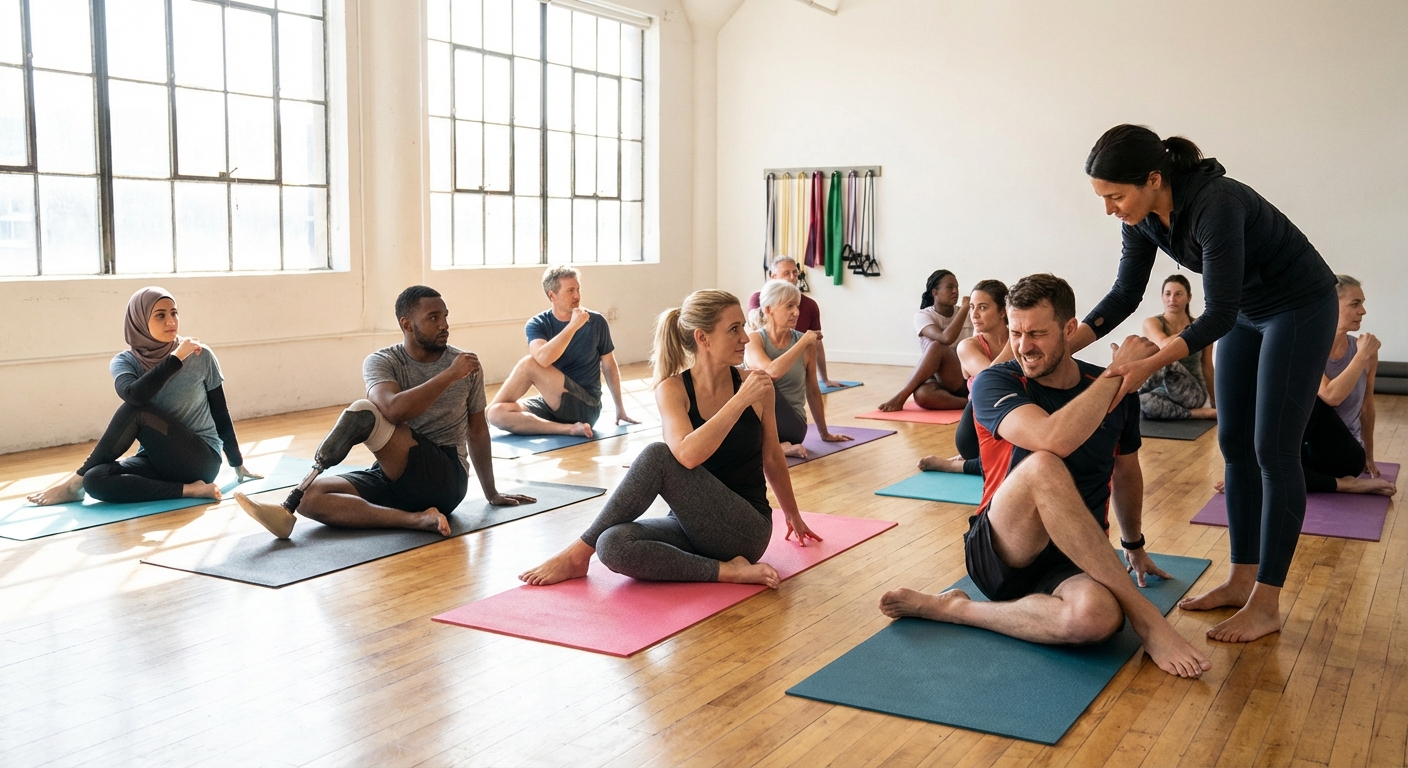
If you train hard—lifting, running, cycling, or competing—you’re loading muscles and joints repeatedly. Without dedicated mobility work, your performance ceiling drops:
Why Athletes Need More Than Strength and Cardio
- Shortened, overworked muscles
- Compensations and poor mechanics
- Increased injury risk
Yoga offers a systematic way to restore and expand range of motion, while building endurance, balance, and joint stability. A structured plan beats random stretches. Below is a 6-week flexibility blueprint that meets you where you are and grows with you.
How This 6-Week Plan Works
- Frequency: 3 sessions per week (non-consecutive days)
- Time: 20–35 minutes per session
- Focus: Hips, hamstrings, spine, shoulders—key areas for most athletes
- Style: Mix of static holds, active mobility, and breath-focused flow
Progression Phases
- Weeks 1–2: Reset and Awareness
Learn fundamental poses, basic breathing, and safe alignment.
- Weeks 3–4: Expansion and Control
Longer holds, more active ranges, and integrated flows.
- Weeks 5–6: Performance Flexibility
End-range strength, deeper work, and sport-specific carryover.
Getting Started: Baseline Assessments
Before day 1, record simple markers:
Forward Fold Reach
Stand tall, hinge forward, legs straight but not locked. - Note: fingertips above knees / mid-shin / ankles / floor / palms flat.
Deep Squat Comfort
How low can you squat without heels lifting or pain? Use 0–10 comfort scale.
Overhead Reach
Stand with back to wall, heels a few cm forward, lower back lightly touching wall. Raise arms overhead. Can they touch the wall without arching your back?
Take photos in each position, then repeat at weeks 3 and 6.
Weeks 1–2: Reset and Awareness (20–25 Minutes)
Goal: Build consistency, learn safe form, and gently increase range of motion.
Session Template (3x per week)
Breath Primer (2 minutes)
- Sit or lie comfortably. - Inhale 4 seconds through nose, exhale 6 seconds. - This primes your nervous system for relaxation.
Dynamic Warm-Up (5 minutes)
- Cat–Cow: 10 slow cycles. - Shoulder Rolls: 10 each direction. - Hip Circles (hands on hips): 10 each direction.
Core Sequence (5 minutes)
Strong, responsive core supports safe flexibility.
- Dead Bug x 8 each side
Lie on back, arms up, knees over hips. Lower opposite arm/leg, keep low back gently pressed into floor.
- Forearm Plank x 20–30 seconds
Elbows under shoulders, body in straight line. Think “ribs to hips.”
Flexibility Flow (10–12 minutes)
Hold each pose 4–6 breaths.
- Low Lunge (Anjaneyasana) – hips & hip flexors
- Half Splits (Ardha Hanumanasana) – hamstrings
- Thread the Needle (Figure-4 on Back) – glutes/hips
- Sphinx Pose – gentle spinal extension
- Supine Twist – spine and outer hips
Cool-Down Check-In (1–2 minutes)
- Quick mental scan: neck, shoulders, back, hips, hamstrings. - Note any area that feels dramatically tighter—this may need extra attention.
Form Tips for Beginners
- Use props (blocks, pillows, books) to bring the floor up to you.
- Keep breath smooth; if you’re holding your breath, you’ve gone too far.
- Always move into a pose, never force yourself into one.
Weeks 3–4: Expansion and Control (25–30 Minutes)
Goal: Increase time under tension and improve active control of new ranges.
Session Template (3x per week)
Breath + Intention (2 minutes)
- Same breathing pattern (4 in, 6 out). - Set a simple intention: “I build strength in new ranges” or “I stay patient.”
Active Warm-Up (5 minutes)
- Sun Salutation A x 3 rounds (modified if needed): - Mountain → Forward Fold → Half Lift → Plank → Cobra or Up Dog → Down Dog → step forward → Half Lift → Fold → Mountain.
Flexibility Strength Block (10–12 minutes)
- Crescent Lunge with Active Glute
- Press back heel away, gently squeeze back glute, lift ribs over hips.
- 5–8 breaths each side.
- Warrior II → Side Angle Flow
- 3–5 slow transitions with control per side.
- Focus on knee tracking and hip openness.
- Chair Pose with Arm Variation
- Feet hip-width, sit back like a squat, arms overhead.
- Strengthens hips and quads to control kneeling and squatting angles.
- Pigeon or Reclined Figure-4: 1–2 minutes per side.
- Wide-Leg Forward Fold: 1–2 minutes.
- Shoulder Stretch at Wall: Forearm on wall, gently rotate chest away, 45–60 seconds per side.
Deep Stretch Block (8–10 minutes)
Brief Body Scan (1 minute)
Notice: Do positions from week 1 already feel more accessible?
Weeks 5–6: Performance Flexibility (30–35 Minutes)
Goal: Combine flexibility with stability and sport-specific control.
Session Template (3x per week)
Dynamic Warm-Up Flow (5 minutes)
- 2–3 rounds of: - Cat–Cow (5 breaths) - Down Dog (5 breaths) - Step to Low Lunge (3 breaths) → Half Splits (3 breaths) → Step back.
End-Range Strength Block (12–15 minutes)
- Lizard Lunge with Isometrics
- From lunge, hands inside front foot.
- Gently press front foot and back toes into floor for 5 seconds, then relax deeper.
- 3–4 rounds per side.
- Half Splits with Active Dorsiflexion
- In Half Splits, flex front toes toward face, then slowly point them.
- 8–10 slow reps per side.
- Single-Leg Bridge Holds
- 3 x 20–30 seconds per leg.
- This creates strength to support hamstring length gains.
- Malasana (Deep Squat) – 1–2 minutes
- Use heel support if needed; keep chest lifted.
- Seated Straddle Fold – 2–3 minutes
- Legs wide, hinge forward. Use support under hips if low back rounds.
- Optional Progression:
- If nearing splits, spend 2–3 minutes in Supported Front Split using blocks under hands and perhaps under front thigh.
Advanced Stretch Block (10–12 minutes)
Performance Reflection (2–3 minutes)
Ask:
- Do your lifts feel more stable and smooth at depth?
- Has your running stride or pedal stroke become more fluid?
- Do you recover faster from hard sessions?
Document these observations.
Nutrition and Recovery to Supercharge Flexibility Gains
Flexibility adapts like muscle and strength—it needs recovery and building blocks.
- Protein:
Aim for 1.6–2.2 g/kg body weight if you train intensely. Protein repairs tissues stressed in long holds and new ranges.
- Carbohydrates:
Carbs support nervous system function and training intensity. Under-fueling can increase perceived stiffness and fatigue.
- Healthy Fats:
Support hormone function and reduce chronic inflammation. Include sources like olive oil, avocado, nuts, seeds, and fatty fish.
- Micronutrients:
- Vitamin C: citrus, berries, peppers—for collagen synthesis.
- Magnesium: nuts, seeds, leafy greens—for muscle relaxation and nerve health.
- Calcium + Vitamin D: for bone and muscle function.
- Sleep:
7–9 hours per night. Tissue remodeling (including connective tissue) happens most at night.
Tracking Your 6-Week Flexibility Transformation
Use simple, objective tools:
- Week 0, 3, 6 Photos: Forward fold, deep squat, overhead reach.
- Range Scoring: Rate each position (0–10) for comfort and depth.
- Training Log: Track sessions, note 1–2 sentences on how your body felt.
Look for trends, not perfection:
- Slightly deeper folds without pulling sensations.
- Less "day-after" stiffness from heavy training.
- More control in lunges, squats, and overhead lifts.
Bring It All Together
In six weeks, you won’t become a contortionist—and you don’t need to. You’ll gain functional, usable flexibility: better squat depth, smoother running mechanics, healthier shoulders, and a spine that moves instead of locks.
Stick with the plan. Adjust intensity, not consistency. Yoga isn’t just about stretching; it’s about teaching your body—and your brain—to trust new ranges, making you more resilient and powerful in every workout you do.