
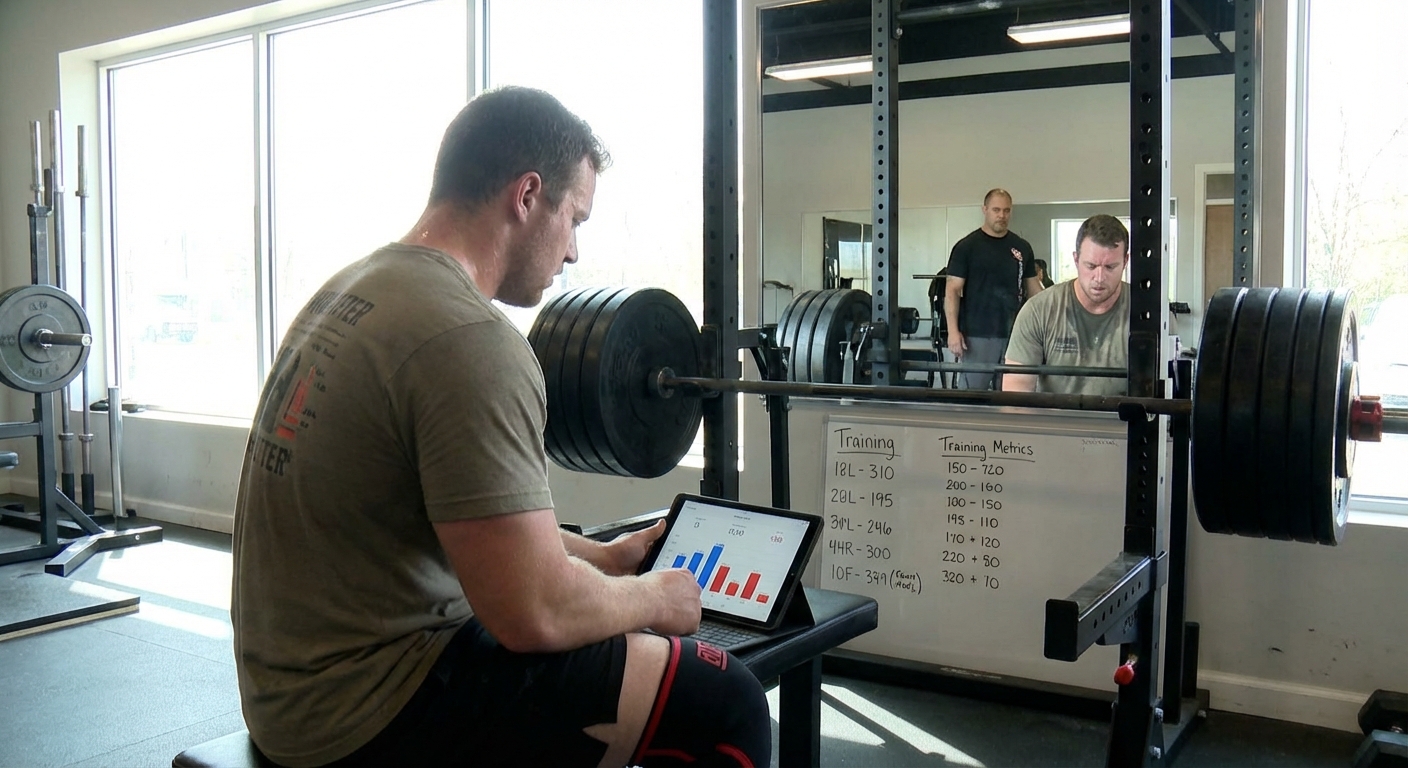
Many lifters train hard but not necessarily smart. They repeat the same workouts, use the same weights, and rely on the mirror to tell them if it’s working. Strength training becomes far more effective and motivating when you treat it as a data-informed experiment instead of a random grind.
Stop Guessing, Start Measuring
This article shows you how to:
- Track what actually matters for strength
- Use simple testing to guide your training
- Spot early signs of progress or overtraining
- Adjust your plan using objective and subjective feedback
You don’t need fancy technology—just a notebook or app, honesty, and consistency.
The Four Pillars of Data-Driven Strength
- Training load and volume – How much work you’re doing.
- Performance indicators – How well you’re doing it.
- Recovery markers – How your body is handling it.
- Body composition and subjective feel – How your body is adapting.
Let’s break these down into actionable tools.
Pillar 1: Track Training Load and Volume
Your body adapts to the total stress of training: sets, reps, and load.
Essential Metrics to Log Every Session
For each exercise:
- Exercise name
- Sets, reps, and weight used
- RIR (Reps In Reserve): How many reps you could have done before failure (estimate)
Example entry:
Back Squat – 4 x 5 @ 100 kg, RIR 2, felt solid, slight fatigue in last set.
This provides the foundation to apply progressive overload and avoid random training.
Weekly Volume Overview
Instead of obsessing over each workout, look at weekly volume by muscle group (total hard sets per week):
- Minimum effective dose: ~8 sets/muscle/week
- Typical growth range: 10–20 sets/muscle/week
Beginners should start at the low end; advanced athletes might push higher with careful recovery.
Pillar 2: Performance Indicators and Testing
Testing doesn’t always mean going to a true 1-rep max. You can use safer, repeatable methods to gauge progress.
Key Performance Tests (Every 8–12 Weeks)
Rep Max Tests
- Example: Max reps at 70% of your estimated 1RM on squat, bench, or deadlift. - If your reps at a given load increase over time, you’re stronger.
Strength Endurance Tests
- Push-ups in 2 minutes or to technical failure. - Max unbroken pull-ups. - Plank hold time with perfect form.
Speed/Power Markers (for more advanced)
- Vertical jump height (measure against a wall or door frame). - Broad jump distance.
How to Use Tests
- Compare your results to your own previous scores, not others.
- If you’re stalling across multiple tests, it may be time to adjust volume, intensity, or recovery.
Pillar 3: Recovery Markers and Readiness
Strong training demands strong recovery. Overtraining is less common than under-recovering due to poor sleep, nutrition, or stress.
Daily/Weekly Recovery Checks
You can use a simple 1–5 rating scale for each:
Sleep quality (1 = terrible, 5 = great)
Energy levels
Muscle soreness
Motivation to train
Optional but helpful:
- Resting heart rate (RHR): Measure in the morning before getting out of bed. A trend of +5–10 bpm above your baseline for several days may signal fatigue.
Red Flags You Shouldn’t Ignore
If you see any of these trends for more than a week:
- Declining performance despite pushing hard
- Poor sleep, irritability, or constant fatigue
- Persistent joint pain or recurring injuries
It’s time to:
- Reduce training volume by 20–40% for 1 week (deload)
- Prioritize sleep and stress management
- Rebuild training load more gradually
Pillar 4: Body Composition and Subjective Feel
Strength isn’t only about numbers. It’s also about how you feel and function.
Objective Measures
- Body weight: Check 2–3x/week, use a weekly average.
- Girth measurements: waist, hips, chest, arms, thighs every 4–6 weeks.
- Photos: front, side, and back in consistent lighting and posture.
Subjective Measures
- Do everyday tasks feel easier (carrying groceries, stairs, manual work)?
- Do you feel more powerful in sports or recreational activities?
- Are aches and pains decreasing as you get stronger?
These qualitative changes matter just as much as the numbers on the bar.
Building Your Personal Feedback Loop
A feedback loop connects what you’re doing to what’s happening and then to what you’ll change next.
Step 1: Set Clear, Measurable Goals
Examples:
- Add 20 kg to your 5-rep max squat in 16 weeks.
- Perform 8 consecutive pull-ups.
- Do 20 perfect push-ups without rest.
Step 2: Plan Your Training Cycle (6–12 Weeks)
Outline:
- Main lifts and assistance work
- Target sets, reps, and weekly volume
- Progression strategy (when to add load/reps)
Step 3: Collect Data Weekly
- Log all workouts.
- Rate recovery markers (sleep, energy, motivation).
- Note any joint or muscle pains.
Step 4: Review Every 2–4 Weeks
Ask:
- Are loads, reps, or exercise difficulty improving?
- Do I feel more or less recovered?
- Is my volume appropriate or excessive?
Adjust:
- If progressing well and feeling good: continue or add a small amount of volume.
- If stalling but feeling fresh: consider slight increases in intensity (heavier top sets).
- If stalling and feeling fatigued: reduce volume or add a deload week.
Example: Adjusting a Real Program Using Data
Imagine this scenario:
- Goal: Improve 5-rep max on bench press.
- Starting point: 5 x 70 kg.
Weeks 1–4
Training:
- Bench 2x/week: one heavy day (4 x 4–6), one moderate day (3 x 8–10).
- Volume: 7 hard sets per week.
Week 4 data:
- Now benching 5 x 75 kg.
- Sleep and motivation: 4/5.
- RHR stable.
Decision: Progressing well. Keep structure; try to add small load or reps next block.
Weeks 5–8
You increase bench volume to 10 sets/week.
Week 8 data:
- Bench still at 5 x 75 kg.
- Feeling more fatigued, sleep 3/5.
- Joint niggle in shoulder.
Decision: Volume increase may be too much. Reduce to 6–8 sets/week, add a deload week, and address technique/mobility.
Without tracking, you might just “push harder,” risking burnout or injury. With data, you can adjust intelligently.
Tools and Tech (Optional but Helpful)
You don’t need gadgets, but some can make tracking easier:
- Training apps (or a simple spreadsheet) for logging sets/reps.
- Heart rate monitor or smartwatch for RHR.
- Camera phone for form checks and progress photos.
Use tech to enhance awareness, not replace your own judgment.
Mindset: Data as Encouragement, Not Judgment
Numbers are neutral—they’re feedback, not a verdict on your worth or potential.
Use data to:
- Celebrate objective wins, even small ones.
- Catch plateaus early and adjust.
- Stay motivated by seeing trends over months, not days.
Avoid:
- Obsessing over single bad workouts.
- Ignoring how you feel in pursuit of a target number.
Treat your training like a long-term project. Track, test, reflect, and refine. When you combine hard work with honest data, plateaus become puzzles to solve—not walls you crash into.
Your strength story doesn’t have to be random. Make it measurable, and you’ll make it repeatable.