
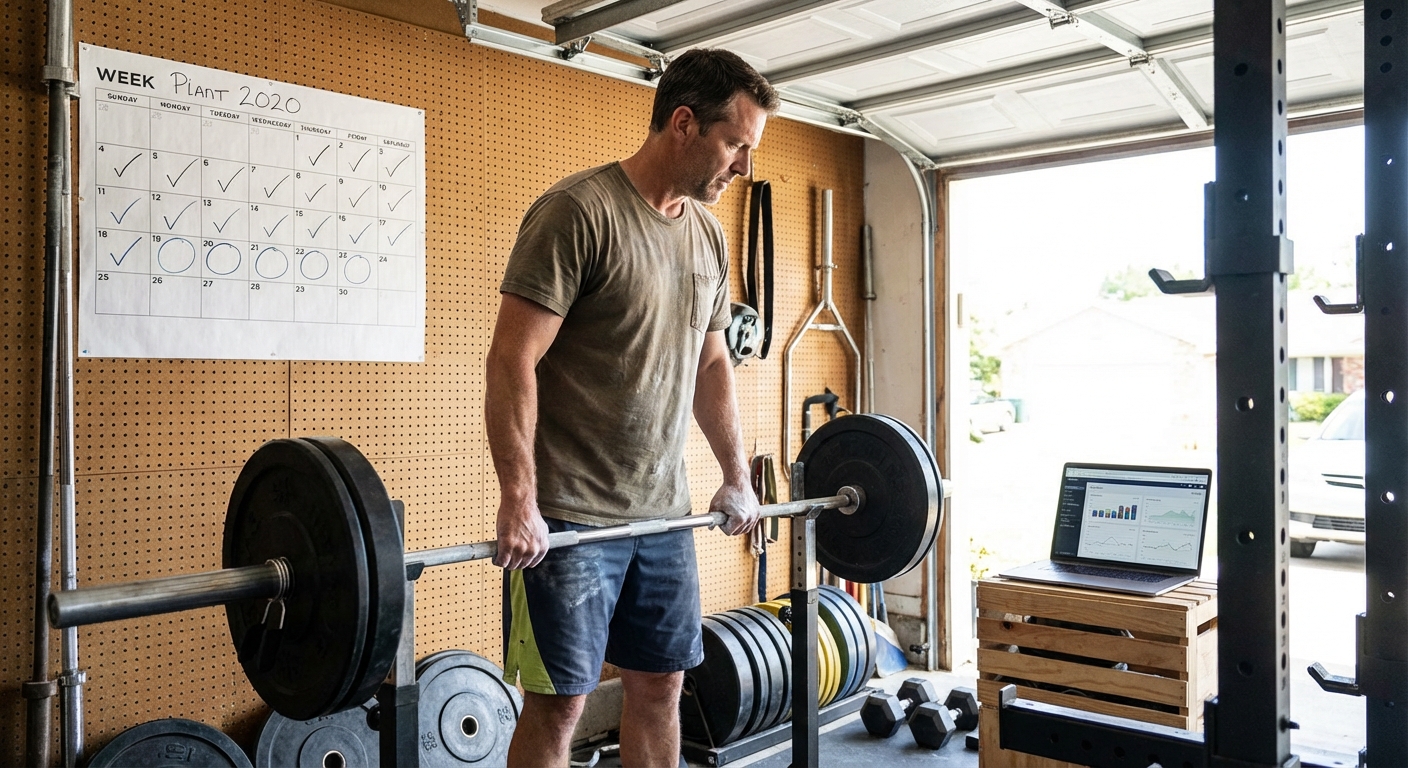
If you want a leaner body, better performance, and long-term health, strength training is the most efficient path. It builds muscle, increases bone density, boosts metabolism, and improves joint stability. Research consistently shows resistance training reduces risk of diabetes, heart disease, and age-related muscle loss (sarcopenia).
Why Strength Training Is Your Best Fitness Investment
You don’t need to be an athlete or gym regular to benefit. With a smart, progressive plan, beginners and advanced lifters can use the same principles, just scaled to their level.
This 12-week blueprint gives you:
- Structured 3-day and 4-day splits
- Evidence-based exercise selection
- Form tips to stay safe and strong
- Simple nutrition guidelines to fuel progress
- Clear strategies for tracking and adjusting
The Science of Getting Stronger (Without Overcomplicating It)
Strength gains come from three main drivers:
- Mechanical tension – Lifting relatively heavy loads with control.
- Progressive overload – Gradually increasing weight, reps, sets, or difficulty.
- Sufficient recovery – Allowing muscles, tendons, and nervous system to adapt.
For most people, the sweet spot is:
- Intensity: 60–85% of your 1-rep max (a weight you can lift for 5–15 reps)
- Volume: 8–20 sets per muscle group per week
- Frequency: 2x per week per muscle group is ideal for progress
This plan hits those targets for both beginners and advanced athletes.
Phase 1 (Weeks 1–4): Foundation and Form
Goal: Learn solid technique, build joint tolerance, and establish consistency.
Training Split: 3 Days/Week Full Body
Example schedule: Monday, Wednesday, Friday
Workout A
Squat (Goblet or Back Squat) – 3 x 8–10
Push-Up or Bench Press – 3 x 8–10
Bent-Over Row (Dumbbell or Barbell) – 3 x 8–10
Glute Bridge or Hip Thrust – 3 x 10–12
Plank – 3 x 20–40 seconds
Workout B
Romanian Deadlift (Dumbbell or Barbell) – 3 x 8–10
Overhead Press (Dumbbell or Barbell) – 3 x 8–10
Lat Pulldown or Assisted Pull-Up – 3 x 8–10
Split Squat or Reverse Lunge – 3 x 8–10/leg
Side Plank – 3 x 15–30 seconds/side
Alternate A and B workouts (e.g., Week 1: A/B/A, Week 2: B/A/B).
Key Form Tips for Phase 1
- Neutral spine: Imagine your spine as a straight, stable pillar. No excessive rounding or arching.
- Brace your core: Before each rep, gently “tighten” your abs as if bracing for a light punch.
- Full range of motion (ROM): Use a ROM you can control. Depth improves over time as mobility and confidence grow.
- Smooth reps: 1–2 seconds up, 2–3 seconds down. No bouncing or jerking.
Progression Rules (Weeks 1–4)
- Start with a weight that leaves 2–3 reps in the tank.
- When you hit the top of the rep range for all sets (e.g., 3 x 10), increase weight by 2–5% next session.
Phase 2 (Weeks 5–8): Build Muscle and Strength
Goal: Increase training volume and challenge key lifts.
Training Split: Upper/Lower (4 Days/Week)
Example schedule: Mon (Upper), Tue (Lower), Thu (Upper), Fri (Lower)
Upper A
Bench Press or Push-Ups (Weighted if needed) – 4 x 6–8
Bent-Over Row – 4 x 6–8
Overhead Press – 3 x 8–10
Lat Pulldown or Pull-Up Variations – 3 x 8–10
Cable or Dumbbell Lateral Raise – 3 x 12–15
Triceps Dips or Pushdowns – 2–3 x 10–12
Lower A
Back Squat or Front Squat – 4 x 6–8
Romanian Deadlift – 3 x 8–10
Walking Lunge – 3 x 10–12/leg
Leg Curl (Machine or Stability Ball) – 3 x 10–12
Standing Calf Raise – 3 x 12–15
Hanging Leg Raise or Reverse Crunch – 3 x 10–15
Upper B and Lower B can use similar movements with slight variations (incline bench, dumbbell rows, hip thrusts, step-ups, etc.) to reduce overuse and keep training engaging.
Intensity and Progression (Weeks 5–8)
- Aim to work closer to 1–2 reps in reserve (RIR) for your main lifts.
- Increase weight when you complete all sets at the top of the rep range with good form.
- If you’re more advanced, consider adding a “top set + back-off sets” structure:
- 1 heavier set of 4–6 reps
- 2–3 back-off sets of 6–8 reps at ~10–15% less weight
Phase 3 (Weeks 9–12): Peak Strength and Performance
Goal: Focus on heavier loads, quality reps, and deliberate progression.
Training Split Options
- Stay with Upper/Lower 4x/week, or
- Move to a 3-day full-body strength focus if recovery feels taxed.
Sample Full-Body Strength Day
Back Squat – 5 x 3–5 (heavy, 1–2 RIR)
Bench Press or Weighted Push-Up – 5 x 3–5
Barbell Row or Weighted Pull-Up – 4 x 4–6
Romanian Deadlift – 3 x 5–7
Farmer’s Carry – 3 x 20–40 meters
You can rotate 2–3 full-body workouts across the week emphasizing squat, hinge, push, and pull patterns.
Deload Week (Optional but Recommended)
Around week 10 or 11, consider a deload:
- Reduce loads to ~60–70% of usual
- Cut sets in half
- Focus on clean technique and faster recovery
Research and coaching experience both show periodic deloads can help prevent plateaus and reduce injury risk.
Nutrition: Fueling Your Strength Gains
You don’t need a complicated meal plan. You need consistency and the right targets.
Protein
- Aim for 1.6–2.2 g protein per kg of body weight per day (0.7–1.0 g/lb).
- Prioritize: lean meats, eggs, dairy/Greek yogurt, whey or plant protein, beans, lentils, tofu, tempeh.
Calories
- To build strength and muscle, most people benefit from a small surplus of ~200–300 calories above maintenance.
- If fat loss is also a goal, use a small deficit but accept slightly slower strength gains.
Carbs and Fats
- Carbs help performance: focus on whole grains, fruit, potatoes, rice, oats.
- Fats support hormones and recovery: include nuts, seeds, olive oil, avocado, fatty fish.
Hydration
- Dehydration as low as 2% of body weight can impair strength.
- Aim for 2–3 L of water daily, more if you sweat heavily.
Tracking Progress Like an Athlete
Numbers remove guesswork and emotion.
What to Track Weekly
- Loads and reps for key lifts (squat, hinge, bench/push, pull).
- Body weight (2–3x per week average).
- Performance notes: energy, sleep, any joint discomfort.
Simple Progress Benchmarks (After 12 Weeks)
Approximate goals for healthy adults:
- Perform 10 quality push-ups (or +10–20% added load if already strong).
- Perform 8–10 bodyweight rows or 3–5 pull-ups (assisted or unassisted).
- Squat and hinge more weight with better depth and control than week 1.
If numbers are improving and you feel more capable, the program is working.
Mindset: Strength Training as a Long-Term Identity
Real strength is built over years, not weeks. But 12 focused weeks can be life-changing:
- Joints feel more stable.
- Everyday tasks feel lighter.
- Confidence in and out of the gym rises.
Think like an athlete:
- Beginner: Master form and show up consistently.
- Intermediate: Refine technique and push progressive overload.
- Advanced: Optimize recovery, micro-adjust volume, and chase long-term PRs.
Your only real competition is your previous self. Add 1–2 reps, 2–5 kg, or slightly better technique each week. That’s how beginners become beasts.
Commit to the full 12 weeks. Track, adjust, and stay patient. Your future, stronger self is built one focused session at a time.