
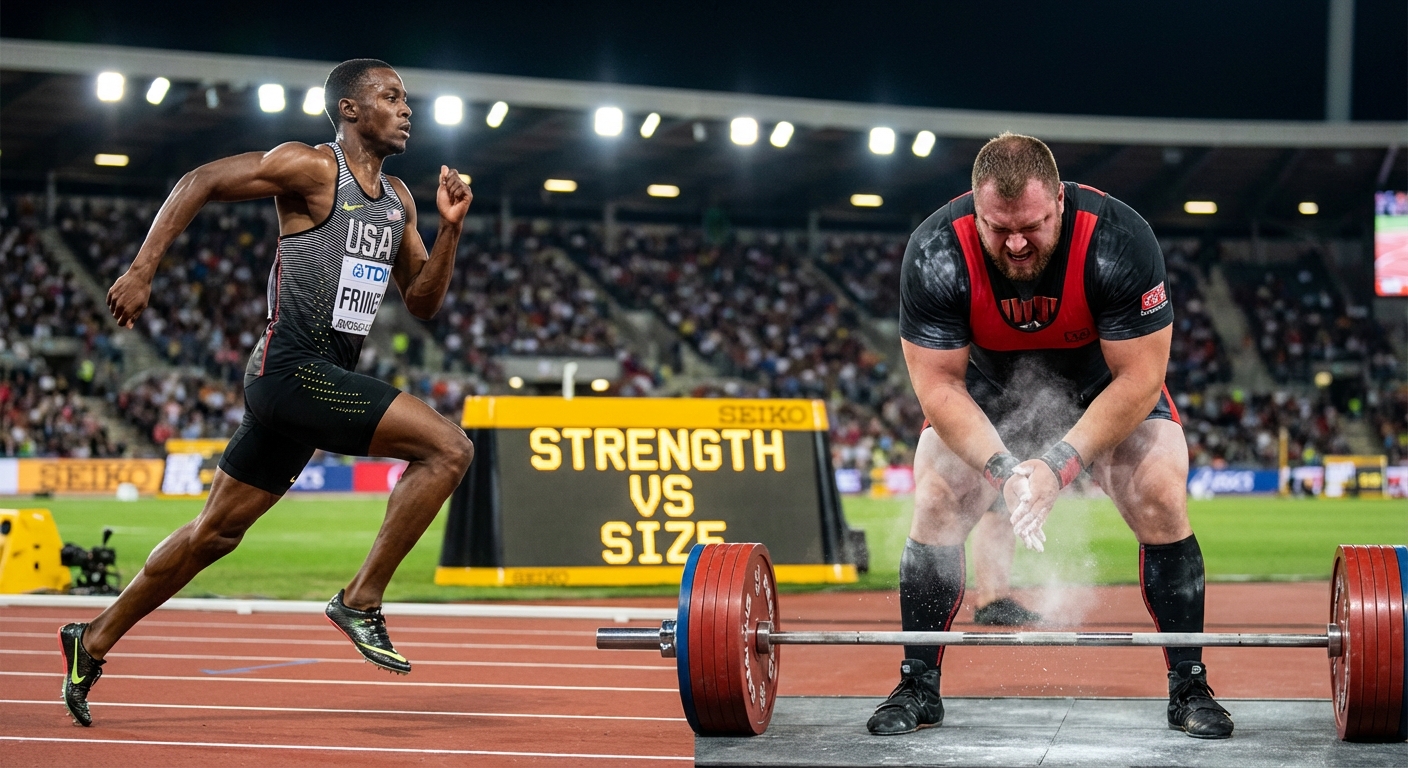
Walk into any gym and you’ll see it: some lifters are incredibly strong but don’t look huge; others look jacked but can’t move much weight. That’s because training for maximum strength and training for maximum muscle size (hypertrophy) are related but not identical.
Strength vs Size: You Don’t Have to Choose
The good news? With the right approach, you can train in a way that makes you strong like an athlete and built like one too.
This guide breaks down:
- The science of strength vs hypertrophy
- How to structure your weekly training
- Key exercises and rep ranges
- Form tips to maximize both performance and muscle
- Nutrition strategies that support strength and a lean physique
The Science: Strength, Hypertrophy, and the Overlap Zone
Maximal strength is your ability to produce force—moving the heaviest possible load for a low number of reps.
Hypertrophy is about increasing muscle size, mainly by accumulating enough mechanical tension and fatigue over time.
Key Differences
- Strength focuses more on nervous system adaptations: better motor unit recruitment, coordination, and technique under heavy loads.
- Hypertrophy emphasizes muscle tissue stress and volume: enough sets and reps near failure to stimulate growth.
The Overlap Zone
The nice part: there is a large overlap range where you can improve both at once.
- Strength bias: 3–6 reps @ 75–90% 1RM
- Hypertrophy bias: 6–15 reps @ 60–80% 1RM
By spending time in both ranges each week, you get the best of both worlds.
Weekly Training Structure: The Hybrid Athlete Approach
Training 3–5 days per week works well for most people. Here’s a 4-day strength + size hybrid template.
Day 1 – Lower Body Strength + Upper Hypertrophy
Back Squat – 5 x 3–5 (2–3 minutes rest)
Romanian Deadlift – 4 x 4–6
Leg Press or Bulgarian Split Squat – 3 x 8–10
Incline Dumbbell Press – 3 x 8–12
Cable or Chest-Supported Row – 3 x 8–12
Day 2 – Upper Body Strength + Lower Hypertrophy
Bench Press – 5 x 3–5
Weighted Pull-Up or Heavy Lat Pulldown – 4 x 4–6
Overhead Press – 3 x 5–7
Walking Lunges – 3 x 10–12/leg
Leg Curl (machine or ball) – 3 x 10–15
Day 3 – Rest or Active Recovery
Light walking, mobility, foam rolling. Keep it easy.
Day 4 – Lower Hypertrophy + Posterior Chain
Front Squat or Hack Squat – 3 x 6–10
Hip Thrust or Glute Bridge – 3 x 8–12
Single-Leg Romanian Deadlift – 3 x 8–10/leg
Calf Raises – 3 x 12–15
Core: Hanging Leg Raise or Cable Crunch – 3 x 10–15
Day 5 – Upper Hypertrophy + Strength Accessories
Dumbbell Bench or Weighted Push-Up – 3 x 6–10
Chest-Supported Row or T-Bar Row – 3 x 6–10
Lateral Raises – 3 x 12–15
Face Pulls or Rear Delt Flyes – 3 x 12–15
Biceps Curl + Triceps Pushdown Superset – 3 x 10–15 each
Beginners can start with 3 days by removing Day 5 and sharing some accessory work across the remaining days.
Technique Cues to Maximize Strength and Size
For your main lifts (squat, deadlift/hinge, bench, row, overhead press), precision matters.
Squat
- Stance: Just outside hip-width, toes slightly out.
- Descent: Break at hips and knees together; sit ‘between’ your hips, not forward into your knees.
- Depth: Aim for thighs at least parallel to the ground, within your mobility and comfort.
- Drive: Push the floor away, keep chest proud, and knees tracking over mid-foot.
Deadlift / Romanian Deadlift
- Hinge pattern: Push hips back, keep shins mostly vertical.
- Back position: Neutral, not rounded; brace before moving.
- Bar path: Keep the bar close to your body—almost sliding along your legs.
Bench Press / Push-Up
- Shoulder position: Slight arch in the back, shoulder blades pulled together and down.
- Elbow angle: Roughly 45° from your torso, not flared out.
- Bar path: Lower to mid-chest, press slightly back toward the face.
Row / Pull-Up
- Initiate with your back: Pull your shoulder blades toward your spine before bending the elbows.
- Finish strong: Squeeze the shoulder blades together briefly.
Progressive Overload: Different for Strength and Size
For Strength-Focused Lifts (3–6 reps)
- Add 2–5 kg when you complete all sets with 2 reps in reserve.
- If you stall for multiple weeks, reduce load by ~10% and build back up.
For Hypertrophy-Focused Lifts (6–15 reps)
- Aim to get within 0–2 reps of failure on the final set.
- When you can do the top end of the rep range on all sets, add weight next session.
Use a training log or app so you’re not guessing. Strength and size both respond to consistency and quantifiable progression.
Nutrition: Looking and Performing Like an Athlete
To be strong and lean, you need to support performance while managing body composition.
Step 1: Dial In Protein
- Target 1.6–2.2 g/kg of body weight daily.
- Include lean protein at each meal: eggs, poultry, fish, dairy, lean beef, tofu, tempeh, legumes, and protein powders.
Step 2: Match Calories to Your Goal
- Recomposition / lean gains: Eat around maintenance or in a very slight surplus (100–200 kcal).
- Cutting while keeping strength: Use a modest deficit (300–500 kcal) and keep protein high.
Step 3: Carbs for Performance
- Carbs = fuel. For most active lifters: 2–5 g/kg/day depending on training volume.
- Eat a carb + protein meal 1–3 hours pre-workout (e.g., rice and chicken, oats and Greek yogurt).
Step 4: Fats for Health
- Aim for 0.5–1.0 g/kg/day.
- Focus on: olive oil, avocado, nuts, seeds, fatty fish.
Hydrate well: 2–3 L of water daily, more in hot climates or long sessions.
Tracking Progress: Not Just the Mirror
To know your hybrid plan is working, track both performance and physique.
Performance Metrics
- 3–5 rep maxes (or estimated 1RM) on squat, bench, and deadlift/hinge every 8–12 weeks.
- Rep maxes with submax loads (e.g., weight you can bench for 10 reps).
- Reps of push-ups, pull-ups, dips.
Physique Metrics
- Body weight (2–3x/week average).
- Waist and hip measurements monthly.
- Progress photos every 4–6 weeks, same lighting and poses.
You’re winning if:
- Strength numbers are trending up.
- Your physique is gradually looking leaner or more muscular.
- You feel more athletic: better stamina, power, and control.
Mindset: Train for Capability, Not Just Aesthetics
Chasing numbers only on the scale or only in the mirror can become frustrating. Training like an athlete gives you more ways to win:
- Hit a new squat or bench milestone.
- Add a few clean pull-ups.
- Improve your sprint speed or jump height.
Over months and years, your physique will reflect your capabilities.
You don’t have to choose between strength and size. Build your program in the overlap zone, fuel your training, and stay patient. The combination of power and a confident, athletic physique is earned—not gifted—and you’re fully capable of earning it.