
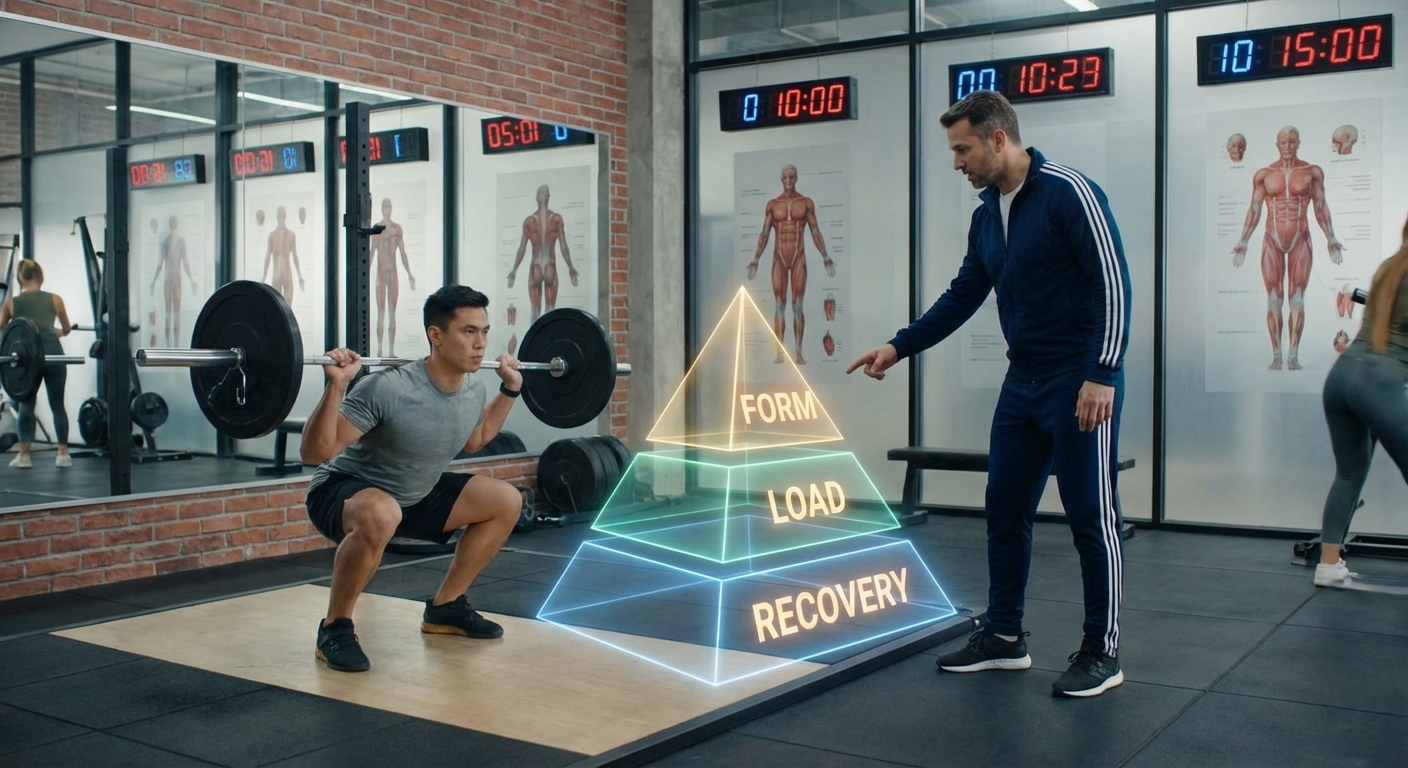
Many lifters obsess over supplements, exotic exercises, or fancy gear. But sustainable strength comes from a simple hierarchy—The Strength Pyramid:
The Strength Pyramid: What Really Matters Most
Technique and Joint Health
Progressive Load and Volume
Recovery and Nutrition
Extras (advanced methods, gadgets, supplements)
Focus on the base first. When your form, loading strategy, and recovery are locked in, everything else becomes more effective.
Level 1: Technique and Joint Health
Before chasing numbers, earn the right to lift heavier. That means building stable, resilient joints and clean motor patterns.
The “Big Four” Movement Patterns
Instead of memorizing dozens of exercises, master four categories that cover your whole body:
Squat
- Examples: goblet squat, back squat, front squat - Primary targets: quads, glutes, core
Hinge
- Examples: deadlift, Romanian deadlift, hip thrust - Primary targets: hamstrings, glutes, lower back
Push
- Examples: push-up, bench press, overhead press - Primary targets: chest, shoulders, triceps
Pull
- Examples: row variations, pull-ups, lat pulldowns - Primary targets: upper back, lats, biceps
Universal Form Rules
Apply these to almost every lift:
- Set your feet: Stable, roughly hip- to shoulder-width unless the exercise demands otherwise.
- Brace your core: Inhale through your nose, brace your abs, then move. Exhale through the effort.
- Control the descent (eccentric): 2–3 seconds down. Don’t drop into the bottom of the movement.
- Own the bottom position: Brief pause; no bouncing off joints or stretch reflex.
- Drive with intent: Lift the weight with purposeful speed while staying in control.
Joint-Friendly Training Habits
- Use a pain-free range of motion. Discomfort that feels like muscular effort is fine; sharp or joint pain is a red flag.
- Vary your grip (overhand, neutral, underhand) and pressing angles to avoid repetitive stress.
- Warm up with 2–3 lighter sets of your main lift instead of random stretches.
Level 2: Progressive Load and Volume
Once form is consistent, progressive overload is non-negotiable. Your body only adapts to what you consistently challenge.
How to Progress Without Guessing
You can increase difficulty by adjusting:
- Load: Add 1–5 kg to your main lifts.
- Reps: Add 1–2 reps per set within a target range.
- Sets: Add 1–2 total sets per muscle group per week.
- Density: Keep the same work but shorten rest periods.
- Complexity: Move from machine to free weights, or from bilateral to unilateral.
A simple rule:
When you can complete all sets at the top of your rep range with 1–2 reps in reserve, add weight next session.
Weekly Strength Template (All Levels)
Aim to train each muscle group 2x/week using this framework:
- Day 1 – Heavy Lower Body
- Squat pattern: 4 x 3–6
- Hinge pattern: 4 x 4–6
- Single-leg exercise: 3 x 8–10
- Core anti-flexion (planks, rollouts): 3 sets
- Day 2 – Heavy Upper Body
- Horizontal push (bench, push-up): 4 x 4–6
- Horizontal pull (row): 4 x 4–6
- Vertical push (overhead press): 3 x 6–8
- Vertical pull (pull-up, pulldown): 3 x 6–8
- Day 3 – Moderate Full Body (Hypertrophy)
- Squat or leg press: 3 x 8–12
- Hip hinge or hip thrust: 3 x 8–12
- Chest or shoulder focus: 3 x 8–12
- Back focus: 3 x 8–12
- Optional arms/shoulders: 2–3 x 10–15
Beginners can use lighter weights and higher reps; advanced athletes can push heavier loads and integrate more top sets.
Level 3: Recovery and Nutrition (Where Many Lifters Fail)
You don’t build strength in the gym. You stimulate the process there; you actualize it during recovery.
Sleep: The Undervalued Performance Enhancer
Multiple studies show that getting 7–9 hours of sleep per night:
- Increases strength and power
- Improves coordination and reaction time
- Enhances muscle growth and fat loss
Prioritize a consistent bedtime, a dark room, and a wind-down routine. No supplement will compensate for chronic sleep debt.
Nutrition for Strength
Calories
- Slight surplus (≈200–300 kcal) if you want max strength and muscle. - Mild deficit (≈300–500 kcal) for fat loss while maintaining strength.
Protein
- 1.6–2.2 g/kg per day - Distribute across 3–5 meals.
Carbs
- Fuel your sessions; aim for 2–5 g/kg depending on activity level. - Time a carb-rich meal 1–3 hours pre-workout for better performance.
Fats
- 0.5–1.0 g/kg per day support hormones and joint health.
Micro-Recovery Between Sessions
- Active recovery: low-intensity walking, cycling, or mobility work.
- Soft tissue work: light foam rolling for tight spots, not punishment.
- Stress management: chronic stress raises fatigue and injury risk; breathing drills and short walks help.
Level 4: Advanced Tactics (Only When the Base Is Solid)
If you’ve been training consistently for 1+ years with good progress, you can sprinkle in advanced methods.
Examples
- Top sets and back-off sets for main lifts
- Paused reps in weak positions (e.g., pause squats)
- Cluster sets for heavy triples or doubles
- Periodization: deliberate cycles of higher and lower volume/intensity
Use these sparingly and track whether they truly help your performance.
Progress Tracking: Metrics That Actually Matter
Skip the mirror-only approach. Use objective and subjective data:
Training Log
- Record: exercise, sets, reps, load, RIR. - Review weekly: Are loads or reps trending up?
Performance Benchmarks
- Can you perform more push-ups, pull-ups, or heavier squats than 4–6 weeks ago? - Are your warm-up sets feeling easier with the same weight?
Recovery Signals
- Resting heart rate (RHR) elevated for several days? - Persistent joint pain? Constant fatigue? These suggest you need to reduce volume or add a deload.
Putting It All Together: A Lifelong Strength Mindset
Your body responds to consistent, intelligent training over time—not to perfection for one week.
- Beginners: Focus 80% of effort on Level 1 and 2—form and progressive load.
- Intermediates: Refine technique, manage volume, and level up your recovery habits.
- Advanced lifters: Periodize training, track closely, and respect deloads.
Think in years, not days. Keep showing up, lifting with intent, eating to support your work, and sleeping like you mean it. That’s how the Strength Pyramid turns into long-term, real-world power you feel in every part of your life.