
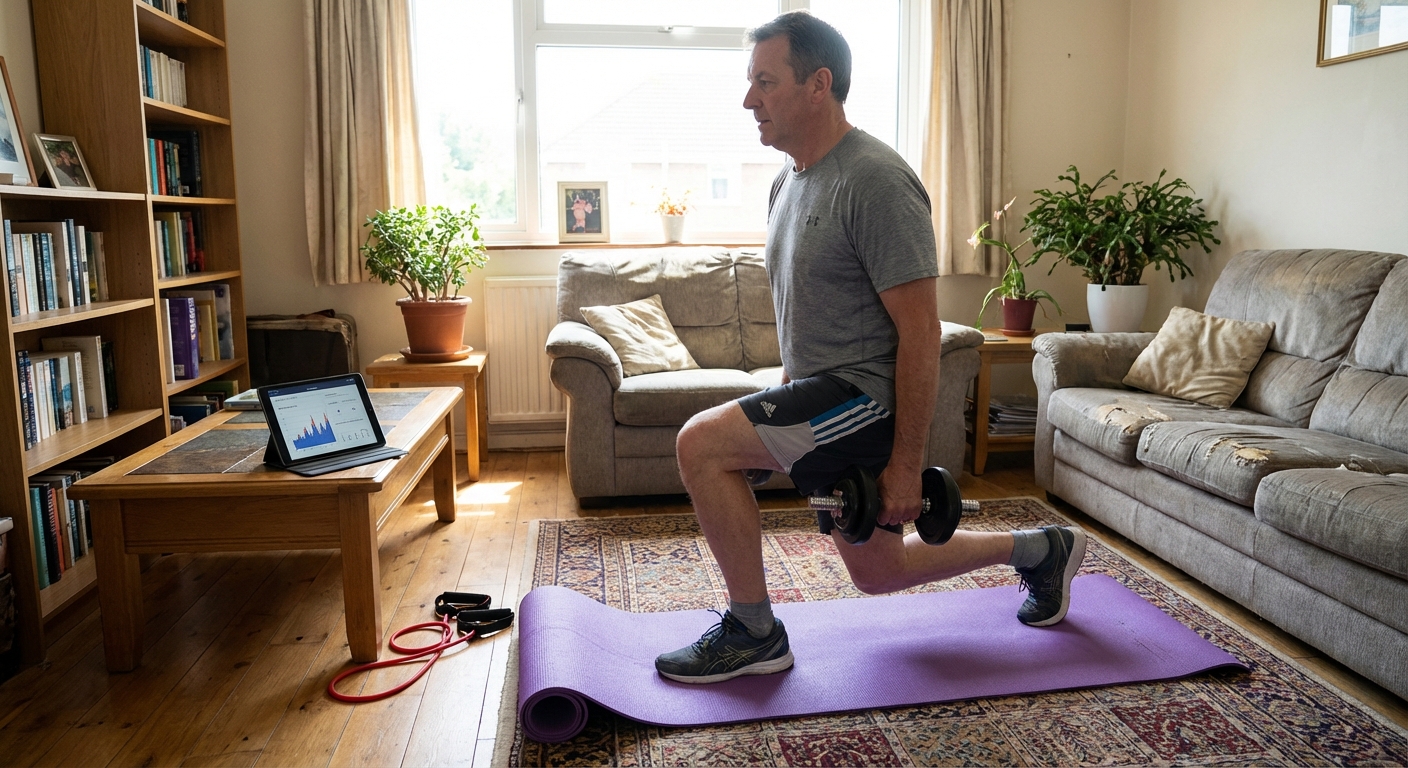
Crowded gyms, commute time, membership costs—none of these should stop you from building real, functional strength. Research is clear: you can gain muscle and strength using bodyweight and light-to-moderate loads as long as you train close to failure and progress over time.
You Don’t Need a Gym to Get Seriously Strong
This guide gives you a full, science-backed home strength system using:
- Bodyweight
- A pair of dumbbells or kettlebells (optional but helpful)
- A sturdy chair/bench and a doorframe pull-up bar or resistance band (ideal, not mandatory)
The Principles: How to Get Strong With Limited Gear
Even with minimal equipment, strength comes from the same pillars:
- Movement patterns: squat, hinge, push, pull, core.
- Progressive overload: harder variations, more reps, more sets, shorter rest.
- Near-failure effort: especially on higher-rep sets.
- Consistency: 2–4 focused sessions per week.
A meta-analysis shows that training with lighter weights (up to 30–40 reps) can build similar muscle to heavy lifting if you work close to failure. That’s great news for home workouts.
Step 1: Movement Pattern Mastery
Design your home routine around these categories.
Squat Variations
- Beginner: Box squat to chair, bodyweight squat
- Intermediate: Goblet squat, split squat
- Advanced: Bulgarian split squat, pistol squat (assisted)
Hinge Variations
- Beginner: Hip hinge with dowel, glute bridge
- Intermediate: Single-leg hip bridge, dumbbell/KB deadlift
- Advanced: Single-leg RDL, hip thrust with load
Push Variations
- Beginner: Wall push-up, incline push-up on counter
- Intermediate: Full push-up, decline push-up
- Advanced: Feet-elevated push-up, pseudo planche push-up, weighted push-up
Pull Variations
- Beginner: Band row around door, towel row under sturdy table
- Intermediate: Inverted row (under table), band pulldown
- Advanced: Doorframe pull-up, towel pull-up, weighted band rows
Core Variations
- Anti-extension: plank, dead bug
- Anti-rotation: side plank, pallof press (band)
- Flexion: reverse crunch, leg raise (used sparingly; focus on stability first)
Step 2: A 3-Day Home Strength Routine
Train 3 days per week (e.g., Mon/Wed/Fri). Rotate between Workout A and Workout B.
Workout A
Squat Pattern – 3–4 sets of 8–15 reps
- Start: bodyweight squat to chair - Progress: goblet squat, Bulgarian split squat
Push Pattern – 3–4 sets of 8–15 reps
- Start: incline push-up - Progress: floor push-up, decline push-up, weighted backpack push-up
Pull Pattern – 3–4 sets of 8–15 reps
- Start: band rows - Progress: inverted rows, pull-ups (assist with band or chair as needed)
Hinge/Glute Focus – 3 sets of 10–20 reps
- Glute bridge → single-leg bridge → hip thrust with load
Core – 3 sets
- Plank: 20–45 seconds (progress to longer or harder variations)
Workout B
Hinge Pattern – 3–4 sets of 8–15 reps
- Start: hip hinge drill + light dumbbell deadlift - Progress: Romanian deadlift, single-leg RDL
Single-Leg Squat or Lunge – 3–4 sets of 8–15 reps/leg
- Split squat → reverse lunge → Bulgarian split squat
Horizontal Pull or Vertical Pull – 3–4 sets of 8–15 reps
- Band rows, towel rows, inverted rows, or pull-ups
Push Variation – 3–4 sets of 8–15 reps
- Different angle than Workout A (e.g., decline push-ups if A uses flat)
Core / Anti-Rotation – 3 sets
- Side plank, dead bug, or band pallof press
Rest 60–90 seconds between sets for most exercises. If an exercise is very challenging, rest up to 2 minutes.
Step 3: Progression Without Plates
You may not have weight plates at home, but you have plenty of progression tools.
Progression Levers
- Reps: Increase reps each week until you reach the top of your range.
- Sets: Add an extra set as you get stronger.
- Tempo: Slow the eccentric (lowering) to 3–5 seconds.
- Pause: Add a 1–2 second pause in the hardest position (bottom of squat, halfway in push-up).
- Leverage: Change body angle to make an exercise harder (more horizontal → harder push-ups/rows).
- Load: Use a backpack with books, water jugs, or any household item as resistance.
A simple rule:
Once you can do 3 sets of 15 high-quality reps for an exercise, make it harder using one or more of the levers above.
Form Tips for Safe, Powerful Home Training
Squats and Lunges
- Keep weight balanced across your whole foot, not just your toes.
- Knees should track in line with your toes—not collapsing inward.
- Lower with control and avoid bouncing at the bottom.
Push-Ups
- Hands slightly wider than shoulders, fingers spread.
- Body in a straight line from head to heels—no sagging hips.
- Chest approaches the floor; elbows at ~45° from your torso.
Rows and Pull-Ups
- Initiate with your shoulder blades, not just arms.
- Keep neck neutral—gaze slightly ahead or at the horizon.
- Full range: arms straight at the bottom, chest leading as you pull.
Core Work
- In planks, avoid hips sagging or piking up.
- In dead bugs, press your lower back toward the floor.
If something hurts in a sharp, joint-specific way, stop and regress the movement.
Nutrition: Strength Gains From Your Kitchen
You don’t need a “bulking diet” to gain strength at home, but some habits make a big difference.
Protein Is Non-Negotiable
- Aim for 1.6–2.2 g/kg body weight per day.
- Include a protein source at each meal: eggs, dairy, meat, fish, tofu, tempeh, beans, lentils, protein powders.
Simple Meal Structure
For most meals, think:
- Protein: palm-sized portion
- Carbs: cupped hand or two (rice, potatoes, oats, fruit)
- Fats: thumb or two (olive oil, nuts, seeds, avocado)
- Veggies: at least a fist or more
Hydration and Timing
- 2–3 L water per day.
- Have a balanced meal 1–3 hours before training.
- If training fasted or early, a quick shake (protein + fruit) can help.
Tracking Progress at Home
You can still track like an athlete, even without machines.
Weekly Metrics
- Reps per set: Are they increasing at the same difficulty?
- Exercise level: Have you moved from incline to full push-ups? From band rows to inverted rows?
- Body weight (optional): Track trends, not daily fluctuations.
Monthly Metrics
- Progress photos in similar lighting.
- Performance milestones:
- 10+ full push-ups.
- 30+ second strong plank.
- First pull-up or a stronger row angle.
If your reps climb, your variations advance, and your body feels more capable week by week, you’re on the right track.
Mindset: Home Training Is Not Second-Class Training
You’re not “settling” for home workouts—you’re choosing a highly efficient, flexible way to train. Many athletes and military personnel have built formidable strength with limited equipment and smart programming.
What matters most:
- Intensity: Work hard, especially on your last sets.
- Consistency: 2–4 strength sessions, every week.
- Progression: Slightly harder goals over time.
Your living room, garage, or backyard can absolutely become the place you rebuild your body and confidence. Treat your home sessions with the same respect you’d give a commercial gym workout, and your results will match your effort.