
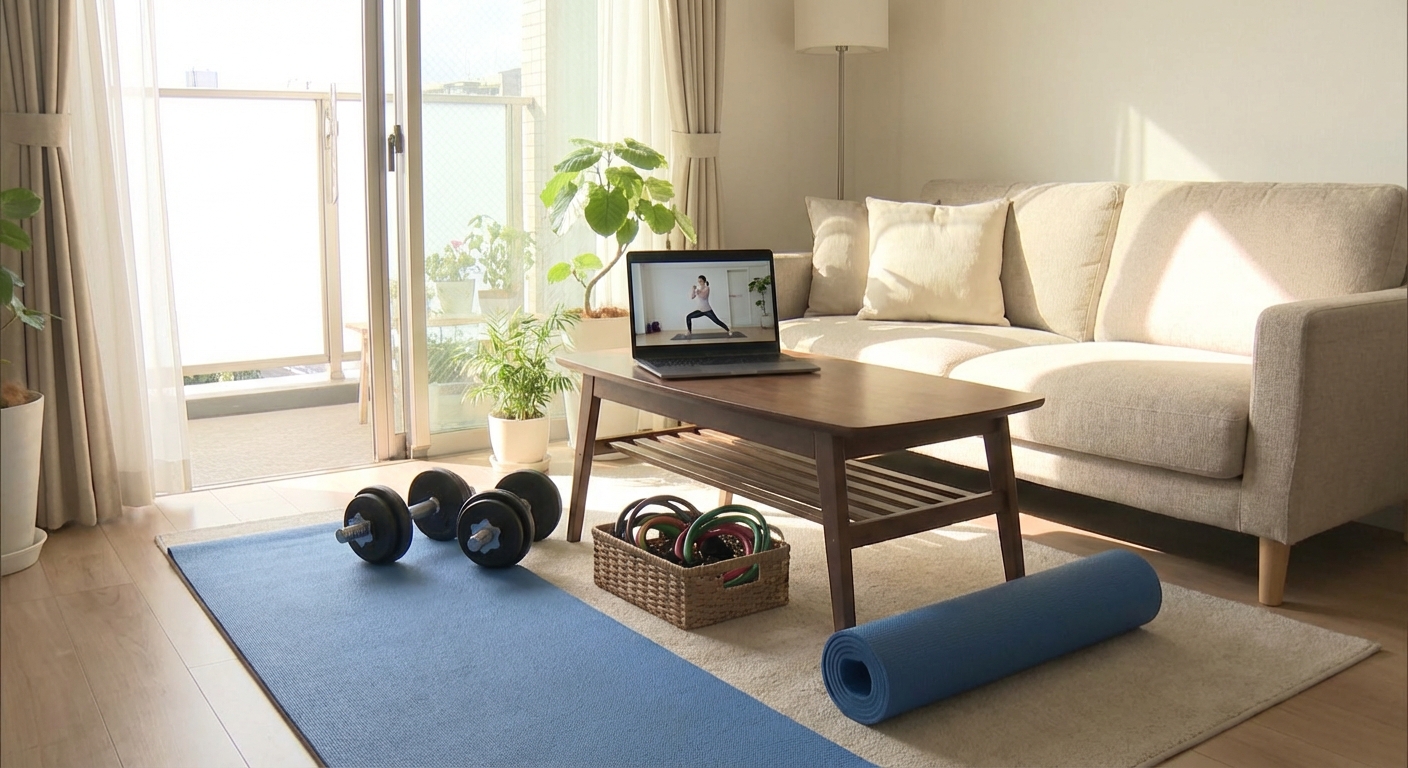
Before you buy a single dumbbell or treadmill, get clear on what you want your body to do:
Start with Your Goals, Not the Gear
- Lift heavier and look more muscular?
- Lose fat and improve conditioning?
- Move better with fewer aches and pains?
Your goals determine your most valuable pieces of equipment. Exercise science consistently points to three pillars of effective training:
Progressive resistance (strength work)
Cardiorespiratory conditioning
Movement quality and consistency
You can hit all three with smart, budget-aware gear choices.
Tier 1: Under $100 – High-Impact Basics
If your budget is tight, prioritize tools that give the most versatility per dollar.
1. Resistance Bands (Loop + Long) – The Ultimate Starter Set
Why they work: Bands provide variable resistance—tension increases as the band stretches. Research shows bands can stimulate strength and hypertrophy similarly to free weights when used with effort and proper progression.
Sample full-body band plan (3x/week):
Day A
- Band squat – 3×12–15
- Band row – 3×10–12
- Band pushup (band around back for resistance) – 3×8–12
- Band Romanian deadlift – 3×12–15
- Band chest press – 3×10–12
- Band overhead press – 3×10–12
Day B
Alternate A and B days.
Form tip: Maintain steady tension at the end range of each rep instead of relaxing—hold for 1 second before lowering.
2. Suspension Trainer or Gymnastic Rings
Why they work: They scale easily: step closer for harder rows and pushups, farther away for easier versions.
Beginner strength circuit:
- Bodyweight row – 3×8–10
- Incline pushup – 3×8–10
- Assisted squat (holding straps) – 3×10–12
Movement quality benefit: The unstable nature of rings encourages your body to recruit stabilizer muscles and sharpen coordination.
3. Floor Mat and Foam Roller
Why they work: Comfort and recovery. You’re more likely to do core work, mobility, and cooldowns if you have a dedicated, comfortable space.
Evidence angle: Consistent low‑intensity movement, stretching, and self‑myofascial release can help reduce perceived stiffness and may improve range of motion.
5-minute nightly mobility sequence:
- Cat‑cow – 10 reps
- Hip flexor stretch – 30 seconds/side
- Child’s pose breathing – 1–2 minutes
Tier 2: $100–$500 – Strength and Conditioning Foundation
Once you’ve built consistency, consider adding gear that enables heavier loading and more cardio options.
4. Adjustable Dumbbells or Kettlebells
Why they work: They unlock progressive overload, a key driver of muscle and strength gains.
Evidence: Numerous studies confirm that training 2–3 times per week with moderate to heavy loads (roughly 60–85% of your 1‑rep max) effectively builds strength and muscle.
Two-day split with dumbbells (for all levels):
Day 1 – Lower & Push
- Goblet squat – 3×6–10
- Reverse lunge – 3×8/leg
- Dumbbell bench or floor press – 3×6–10
- Dumbbell overhead press – 3×8–10
- Dumbbell Romanian deadlift – 3×8–10
- Single-leg hip hinge (supported) – 3×8/leg
- Single-arm row – 3×10/arm
- Farmer carry – 3×30–40 seconds
Day 2 – Hinge & Pull
Increase weights gradually when you can complete the top of the rep range with solid form.
5. Cardio Option: Rower, Bike, or Treadmill
You don’t need a huge machine, but one good conditioning tool can be transformative.
If space or budget is limited:
- Consider a compact air bike or foldable treadmill.
Conditioning templates:
Steady-state (health & base fitness):
- 20–40 minutes at a pace where you can speak in short sentences (Zone 2)
- 1 minute hard, 1–2 minutes easy × 8–12 rounds
Intervals (time-efficient):
Evidence angle: Both steady-state and interval training improve cardiovascular health; intervals can provide similar benefits in less time but are more taxing—use 1–2 times per week.
Tier 3: $500+ – Specialized and Performance Gear
If you have the budget and commitment, you can build a near-complete gym.
6. Barbell, Plates, and Squat Rack
Why they work: Barbells make it easier to apply structured progression in the classic big lifts.
Performance routine (intermediate/advanced):
Day 1 – Squat Focus
- Back squat – 4×4–6
- Romanian deadlift – 3×6–8
- Split squat – 3×8/leg
- Bench press – 4×4–6
- Overhead press – 3×6–8
- Pushup or dip – 3×8–12
- Deadlift – 3×3–5
- Barbell row – 3×6–8
- Chinup or pulldown – 3×6–10
- Use video from the side and front to review your technique. Look for neutral spine, knee tracking over toes, and the bar path close to your center of mass.
Day 2 – Press Focus
Day 3 – Hinge & Pull Focus
Form tip:
7. Specialty Gear (Optional but Powerful)
- Weightlifting shoes for better squat mechanics
- Lifting belt for heavy barbell work
- Plyo box for jumps and step-ups
Use these only once you’ve built a foundation of strength and control.
Exercise Form: The Invisible Gear You Carry Everywhere
No piece of equipment can compensate for poor mechanics. Some universal cues:
- Neutral spine: Avoid excessive rounding or arching. Imagine a straight line from ears to hips.
- Joint stacking: In standing positions, keep ears over shoulders, shoulders over hips, hips over ankles.
- Controlled tempo: 2–3 seconds down, 1–2 seconds up for most strength work.
Beginner priority: move through a full, pain-free range of motion.
Advanced priority: maintain form under heavier load or fatigue.
Nutrition: The Upgrade Your Gear Can’t Provide
Your equipment is only as effective as the energy and building blocks your body has.
Protein
Aim for:
- 1.6–2.2 g/kg/day, spread over 3–5 meals.
This supports muscle repair and growth from resistance training.
Carbohydrates
Adjust to training volume:
- Light training: 3–4 g/kg/day
- Moderate to heavy training: 4–6+ g/kg/day
Use more carbs around your training window (1–2 hours before and after) for energy and recovery.
Fats
Don’t go ultra‑low. About 0.5–1 g/kg/day supports hormonal function and satiety.
Hydrate consistently—small deficiencies in hydration can reduce performance and increase perceived effort.
Tracking Progress in a Home Gym
Without gym PR boards, you’ll need your own system.
Key metrics by gear level
- Tier 1:
- Reps to near‑failure on band exercises
- Time under tension (slower, more controlled reps)
- Tier 2:
- Dumbbell weights and reps
- Interval times and recovery heart rate
- Tier 3:
- Barbell loads for main lifts
- Volume (sets × reps × weight) per session
- Are loads, reps, or distances improving?
- Is form stable or better?
- Are you recovering well between sessions?
Reassess every 4–8 weeks:
If you’re progressing with your current gear, resist the urge to buy more. If you’re plateaued despite consistent training and recovery, a strategic gear upgrade can unlock the next level.
Build the Home Gym That Matches Your Life
The best home gym isn’t the most expensive one; it’s the one you use consistently. Start with minimal but capable tools, layer in heavier equipment as your training evolves, and let exercise science guide your choices.
A thoughtful mix of bands, bodyweight tools, free weights, and one good cardio option—aligned with solid form, smart nutrition, and honest tracking—will carry you from beginner to advanced without wasting money or space.